I Was Told It Was "Hip Bursitis" for 3 Years – It Was Actually Gluteal Tendinopathy. Here's Why Nothing I Tried Ever Worked
How I finally stopped waking at 3 a.m. with a burning ache on the outside of my hip from gluteal tendinopathy – with a simple 15‑minute routine before bed, without stronger pills, more injections or expensive clinic gadgets

Anyone with gluteal tendinopathy – that nagging pain on the outside of the hip – knows how exhausting it is.
You roll onto your side in your sleep – and a deep, burning ache jolts you wide awake.
Stairs become a negotiation. Getting up from the sofa takes a second "run-up". And you lie awake at 3 a.m., afraid to move.
And the worst part: nothing seems to work.
Painkillers take the edge off for a few hours – then the ache comes creeping right back.
I struggled with this for 3 years, until I found out what was really going on in my hip – gluteal tendinopathy, not bursitis – and what to do about it at night.
With a simple 15‑minute routine before bed, plus a few small changes my doctor showed me, I finally got my nights – and my stairs – back.
My story with gluteal tendinopathy
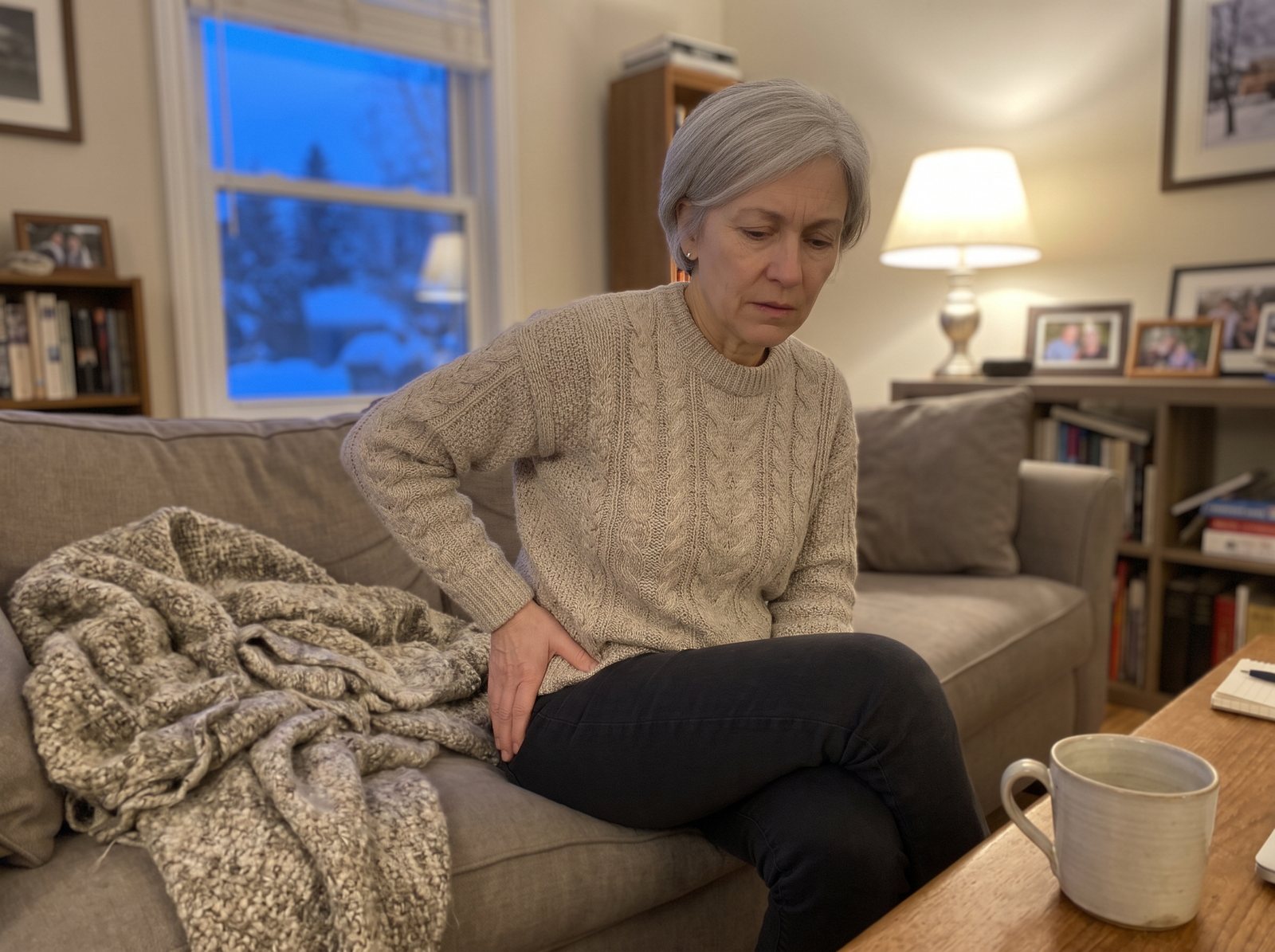
I'm Martha Collins. Three years ago – long before anyone said the words "gluteal tendinopathy" to me – I was told I had "hip bursitis" – a burning ache on the outside of my right hip that spread down my thigh.
There was no fall. No injury. It just crept in, a little worse every month.
By evening, sitting on our low sofa was torture. A flight of stairs felt like a mountain.
I tried stretching videos, a foam roller, a new mattress topper and enough ibuprofen to worry my pharmacist.
The ache always came creeping back.
After 3 years of suffering, I made a decisive discovery
I found a routine that helped me feel noticeably calmer, looser and better rested within just a few weeks.
And the best part: it's completely drug-free.
No pills that pump your body full of chemicals.
No more needles in my hip. No clinic gadgets that cost a fortune.
But not only that: I also found out why my "bursitis" treatments never lasted – and what the 8 hours you spend in bed have to do with all of it.
If you've been diagnosed with gluteal tendinopathy or "hip bursitis" – or you suffer from pain on the outside of your hip, pain lying on your side, or an ache on the stairs – then you absolutely need to read this article.
I searched for the true cause of my problem like a woman obsessed. Now I want to share my findings with the world.
I'm confident it will help you too.
So how did I come across this discovery, and what is it all about?
That winter, I went back to my family doctor one last time.
I was at the end of my rope – I had skipped my niece's birthday because the drive and the hours on a hard chair scared me, and I hadn't slept a full night in months.
I didn't need another prescription. I needed to understand why I was still in pain.
The doctor's visit that changed everything
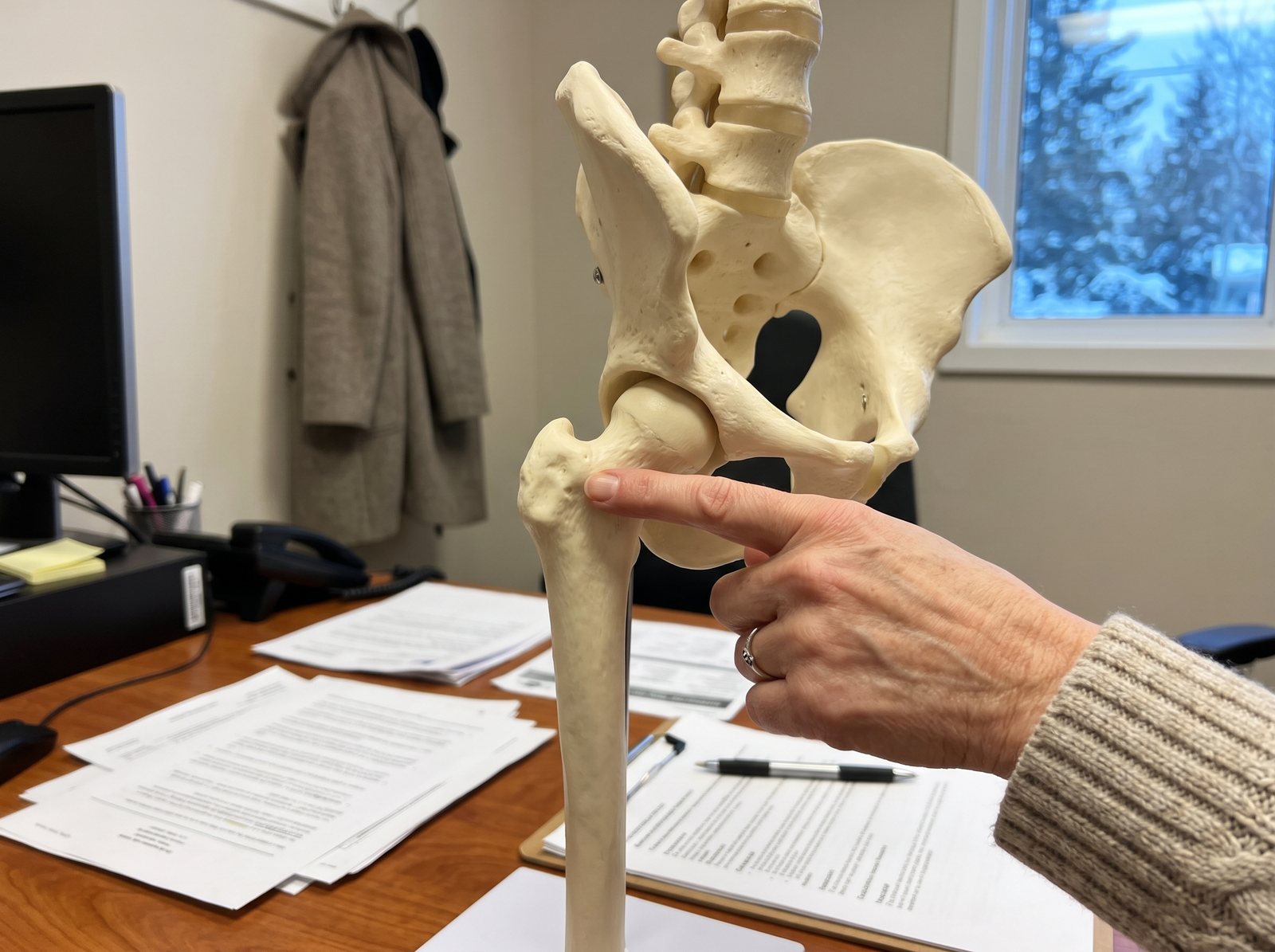
My doctor asked me to stand on my right leg. Within about 30 seconds, the familiar burn lit up on the outside of my hip.
Then she leaned back and asked a question no one had ever asked:
"Martha – has anyone ever told you that this might not be bursitis at all?"
Three years. A cortisone shot. Endless stretching. The honest answer was: no.
"In most women your age, this kind of pain comes from the TENDONS on the outside of the hip. They're being squeezed against the bone – and the more you squeeze them, the angrier they get."
*Important: At this point, I really want to emphasize: if you have hip pain, please absolutely see a doctor first. Pain on the outside of the hip can also come from the hip joint or the lower back – and pain after a fall, sudden weakness, numbness or being unable to put weight on the leg needs urgent medical attention. Get the correct diagnosis and medical guidance before trying anything on your own.
Fortunately, my tests showed no tear and no arthritis.
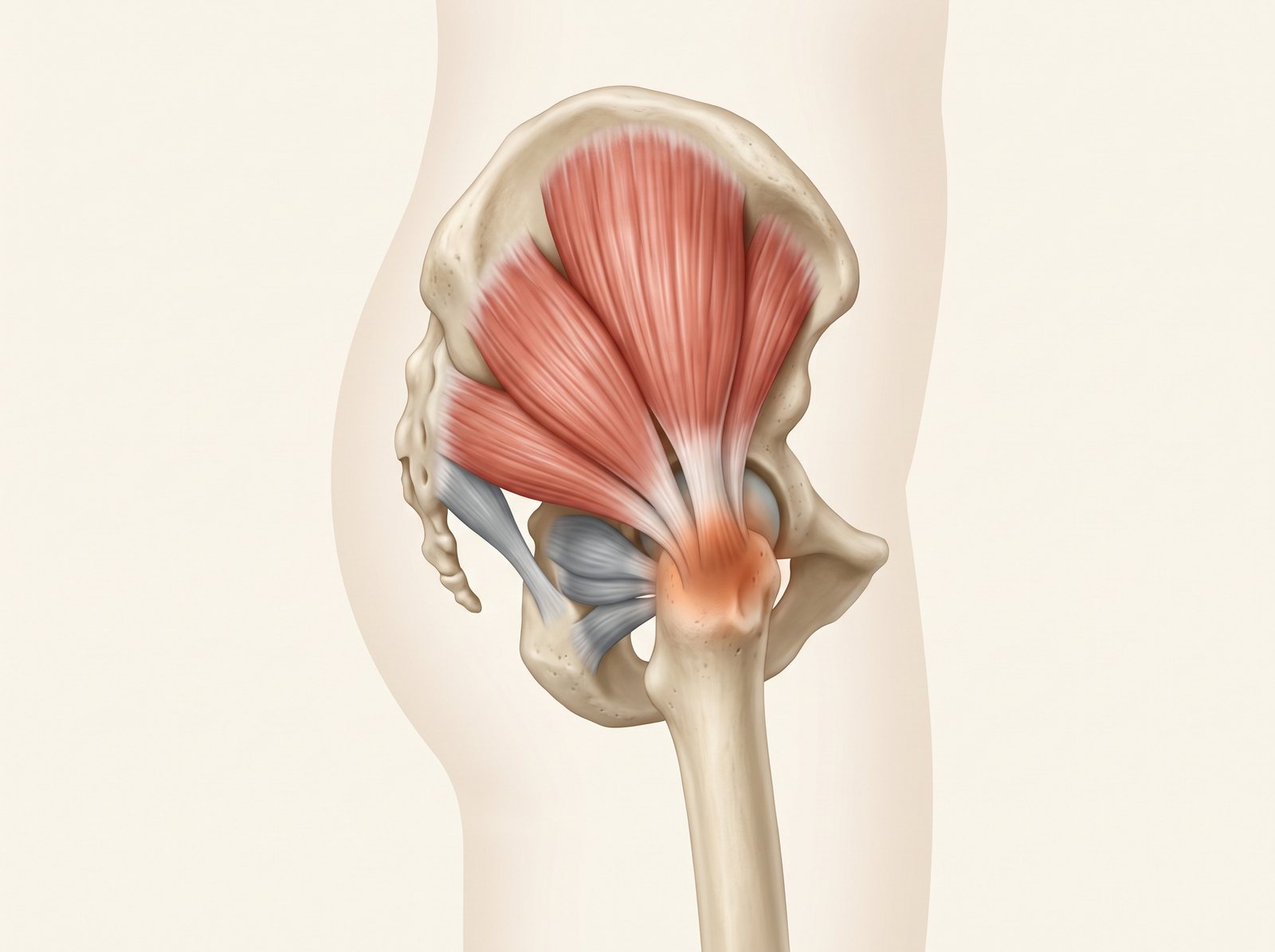
The real diagnosis: gluteal tendinopathy – irritated tendons where the gluteal muscles attach to the bony bump on the side of the hip. She told me it affects around 1 in 4 women over 50 and is very often mislabelled as bursitis.
Gluteal tendinopathy. Three years of the wrong label – and finally a name for what was keeping me awake.
The bad news: her standard gluteal tendinopathy toolkit was exactly what I'd already tried – painkillers, cortisone, stretching or clinic treatments. Most of them aimed at the alarm. Not at what was squeezing the tendon.
The pain actually eased… only to come right back
The painkillers worked at first. For a few hours the ache went quiet.
But the downsides were immediate: stomach pain, drowsiness, and the fear of needing more and more.
And the real problem: the moment a dose wore off – usually around 3 a.m. – the burning came creeping back.
I needed more and more pills just to get through the night.
That's when I realized: numbing the alarm does nothing about what's setting it off.

The last doctor's visit
A few weeks later, I sat in her office and told her the truth: I couldn't live like this anymore.
So I pressed her: if the problem is a squeezed, overloaded tendon – why had nobody told me in three years?
She finally opened up and walked me through every option – and why each one falls short on its own:
1 – Stretching & foam rolling
This is what almost everyone tries first – it's what I did for two years.
Here's what nobody tells you: a patient guide from Britain's Royal Orthopaedic Hospital actually cautions against it. Repeatedly stretching the outer hip and rolling the sore spot can press the tendon even harder against the bone.
In other words, the "fix" I did every evening may have been feeding the problem. Well-known downsides:
- Can add compression to an already irritated tendon
- Feels good for minutes, then the ache returns
- Popular IT band stretches can make things worse
- Rollers, straps and stretching classes cost money and time
2 – Pain medication
The way this works is simple: anti‑inflammatories and other painkillers dull the pain signal for a few hours.
But the effect only lasts as long as the pill. The tendon is still being squeezed every time you cross your legs, sink into a low chair or lie on that side – and long-term use brings stomach trouble, drowsiness and the worry of taking more and more. You're masking the alarm, not changing what triggers it.
3 – Cortisone injections
This is the usual next step for "bursitis": a steroid injected into the side of the hip.
It often brings fast relief – I know, I had one. But in the well-known LEAP trial (BMJ, 2018), the early edge faded: by one year, the injection group was not clearly better off than people who simply waited. Mine wore off in about six weeks.
4 – Shockwave & PRP injections
Here's the part that shocked me most: even the expensive clinic treatments are no guarantee.
A pooled analysis of studies found shockwave and platelet-rich plasma could ease pain for 1 to 3 months – but at 6 to 12 months, no treatment beat doing nothing at all. Multiple sessions, paid out of your own pocket because your provincial plan won't cover them, for relief that may not last.
So not an option for me.
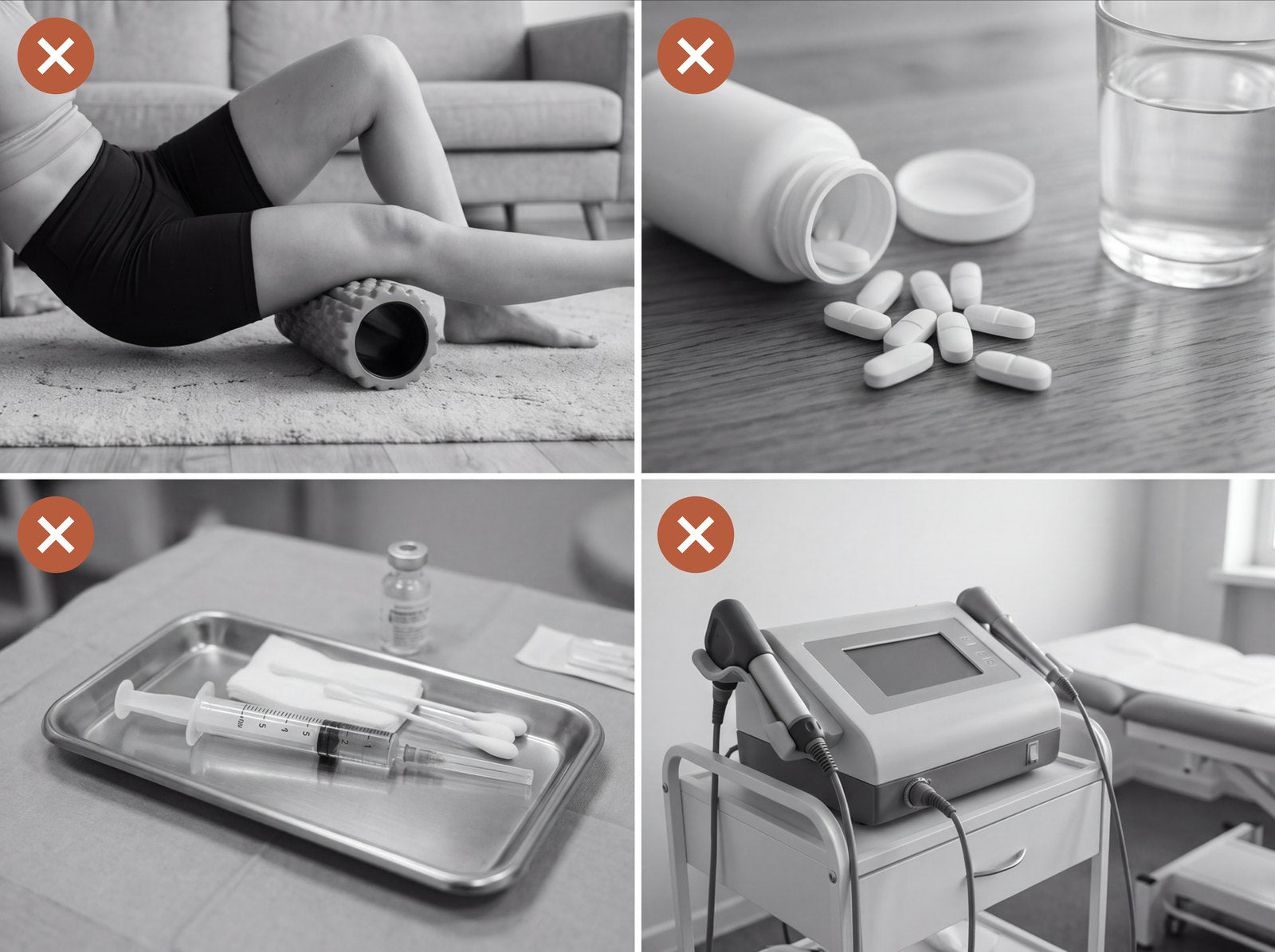
Conclusion: most standard gluteal tendinopathy treatments target the symptom, not the squeeze
None of these approaches change what keeps the tendon irritated – and none of them help where the pressure piles up most: overnight, for 7 to 8 hours in bed.
They either fade the moment you stop, can add pressure to the tendon, or offer no lasting guarantee.
Pills wear off in hours, cortisone fades in weeks, clinic treatments may not outlast a year.
My doctor was honest: what the research supports best is taking the pressure off the tendon and slowly rebuilding hip strength – but that takes weeks, and it does nothing for tonight's 3 a.m. wake‑up.
In addition, the costs of prescriptions, sessions and gadgets keep piling up.
One paper even reports that this condition can affect daily life as much as severe hip arthritis. And as long as only the symptom is fought, the ache keeps coming back. Every time.
The nights – where so much of the damage and so much of the recovery happen – are left completely unsupported.
All roads lead back to the night
Now I knew that pills, cortisone and clinic gadgets weren't a solution for me.
So I fixated on the cause: gluteal tendinopathy – a squeezed, overloaded tendon on the outside of my hip.
And on one crucial detail my doctor mentioned almost in passing:
That same British hospital guide points out that side‑sleeping can press on the sore hip for 7 to 8 hours every single night – and the body does its deepest recovery work while you sleep.
But if you remember: I wasn't sleeping. My nights were the worst part of my day.
Until I asked myself: if the night is where the pressure builds AND where the body recovers – why does every standard treatment ignore it?
I decided to dig deep into how to make my nights work for me instead of against me.
After all, I had no other choice.
I become a root‑cause expert and discover the Mendable Hip Restore
First, I read countless different blogs about gluteal tendinopathy, hip bursitis and natural pain relief.
But that didn't really get me anywhere – half of them told me to stretch even more.
After all, I wanted to know how to calm my hip at night – not just numb the signal.
So I stopped reading blogs and went to the sources themselves: the trial my doctor had mentioned, the review papers on outer hip pain, the hospital guide on how to sleep with it, and the sleep research.
I'm a journalist. Reading the fine print is my job. And for the first time in three years, the pieces started to fit.
Here are the 3 insights that finally made everything click:
#1: It's often not "bursitis" – it's gluteal tendinopathy
Researchers now prefer the umbrella term greater trochanteric pain syndrome – with gluteal tendinopathy as its most common cause – partly because pain in this area often shows no signs of inflammation at all. The tendons on the outside of the hip are a main suspect.
Every day, small habits press those tendons against the bone: crossing your legs, hanging your weight on one hip, sinking into low sofas – and at night, lying on the sore side.
That's why the ache "keeps coming back" no matter what you take for it. What you feel are the downstream signals: burning, aching, pain on stairs, pain lying down.
Fighting those symptoms one by one is pointless. What you need is to take the pressure off – and give your body the calm, restful nights it needs to recover.
#2: The tendon is only as calm as the muscles pulling on it
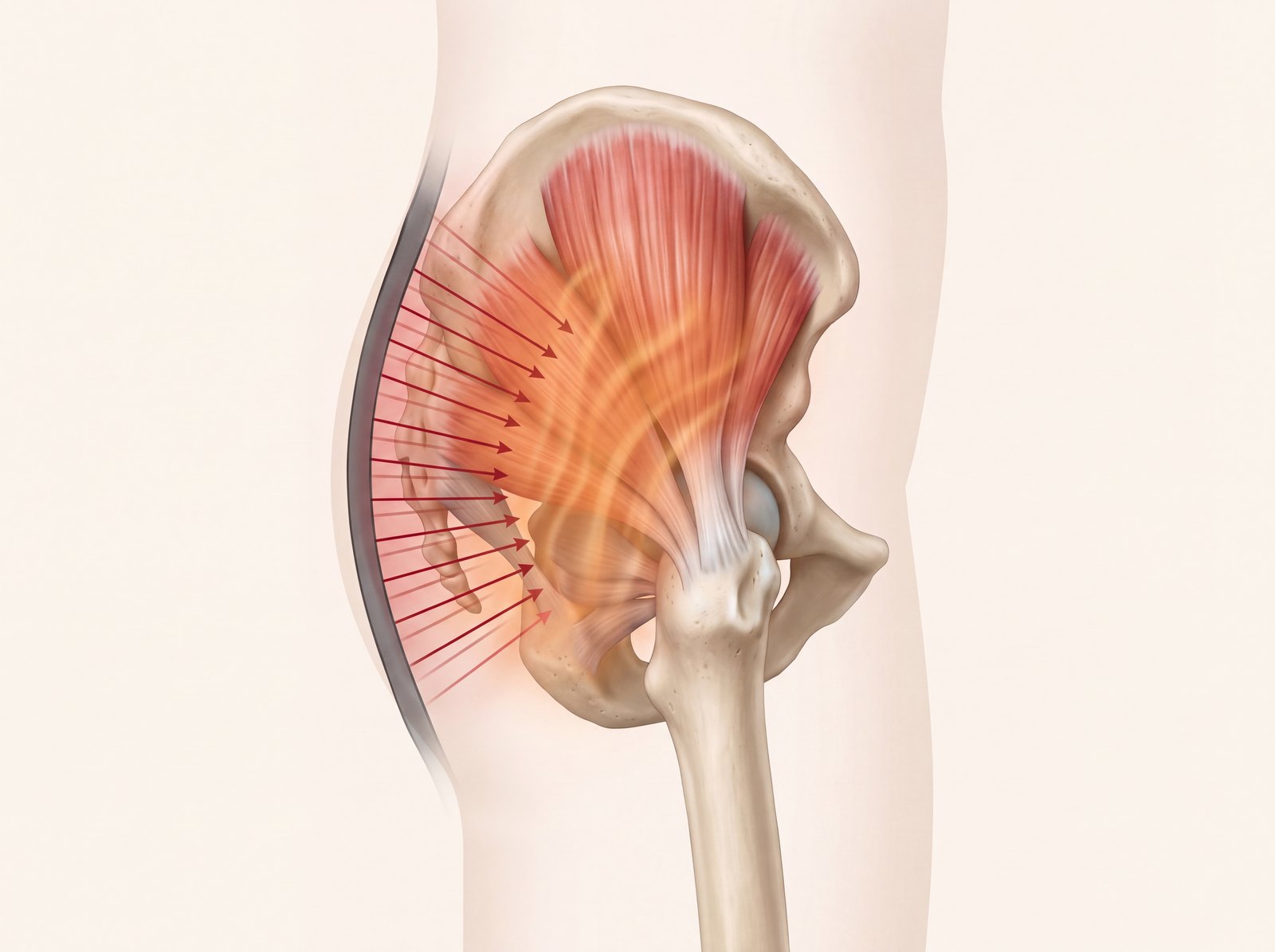
Here's something most of us never think about: a tendon is just the end of a muscle. The gluteal tendons on the outside of your hip belong to the glutes – and right behind them sit the deep rotators.
When those muscles are sore, cold and tense, they clench to guard the hip – and every clench pulls the tendon tighter against the bone. They sit deep under the surface, where no thumb, stretch or foam roller ever really reaches.
I wrote one line in my notebook that winter: cold, tense muscles stay on guard. Warm ones start to let go.
That's exactly what I had never given my hip: something that reaches those deep muscles and lets them stop guarding – without rubbing or stretching the sore spot itself.
#3: Night is when your hip suffers most – and recovers most
Sleep scientists agree: much of the body's repair work happens while you sleep.
But a sore hip wrecks exactly that window. Every time you roll onto it, you wake up – and the tendon gets squeezed again.
And here's what surprised me most: sleep researchers have found that warming the skin before sleep – in their study, the hands and feet – is linked with falling asleep faster (published in Nature, 1999). Other studies suggest that a bad night can make pain feel louder the next day – while a good night's sleep seems to turn the volume down.
In other words: warmth before bed, deeper sleep, a quieter ache. Take the pressure off your hip at night, let the muscles around it stop guarding before you lie down, and you're finally working with your body instead of against it.
- Deep heat
- 660 + 850nm red light
The 15‑minute before‑bed method simply explained
Put the three insights together and you get a beautifully simple routine: Release, Decompress and Repeat – every night, before you sleep. Here's how the whole thing works:
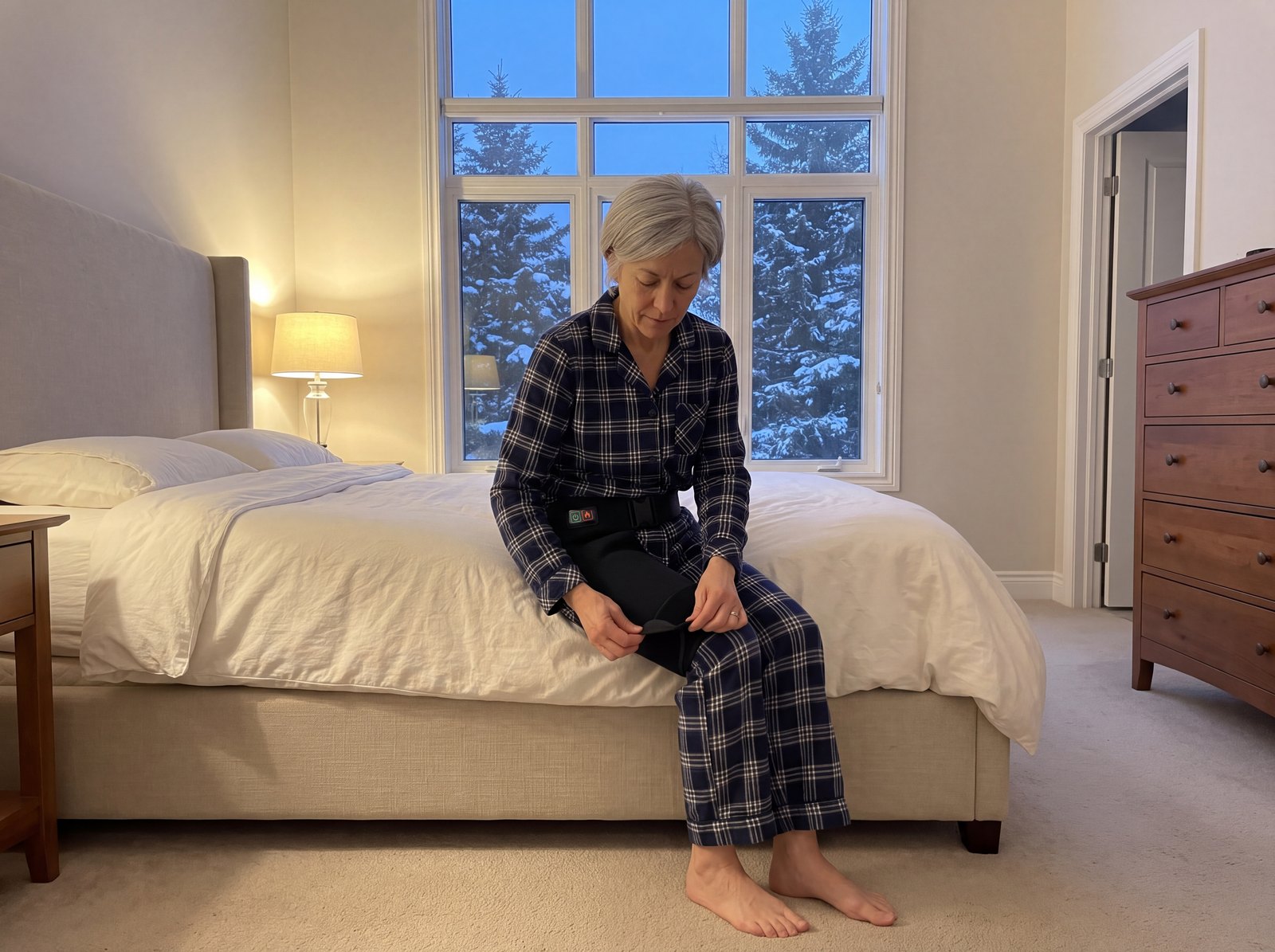
Release. 15 minutes before bed, you wrap the Hip Restore around the sore hip and press one button. Deep heat warms the glutes and the deep rotators, and red light at 660 and 850nm reaches the muscle cells – so the muscles that clench around the tendon finally let go before you lie down.
Decompress. You settle in on your back with a pillow under your knees – or on your good side with a pillow between them – so the sore tendon isn't squeezed for hours. You go to sleep with warm, quiet muscles instead of a guarded, clenched hip.
Repeat. There is nothing to set up and nothing to remember except the time. You simply do it again the next night – 15 minutes at home, as often as your hip needs it.
When I first put all of this together, I was pretty overwhelmed.
But everything made sense.
And what I liked most: unlike pills and injections, this approach doesn't just numb the ache for a few hours – it works on the muscles that keep squeezing the tendon.
Because the routine works with the body's nightly rhythm, not against it.
It also works at home – no needles, no clinic visits, no driving through the snow to an appointment.
The last 15 minutes before bed in particular play a role in recovery that is often massively underestimated.
I finally stumble upon the life-changing solution
I now knew exactly what I needed: something I could use for 15 minutes before bed – something that works on the muscles around the tendon, not just my symptoms.
I'd read enough to know what to avoid: cheap red-light gadgets that glow, warm a little and never say what's inside.
So I set myself one rule. If a device won't print its wavelengths and its mechanisms on the page, it doesn't go near my hip.
I found it soon after: the Mendable Hip Restore.
And it turned out to be the missing piece at the end of my long journey.
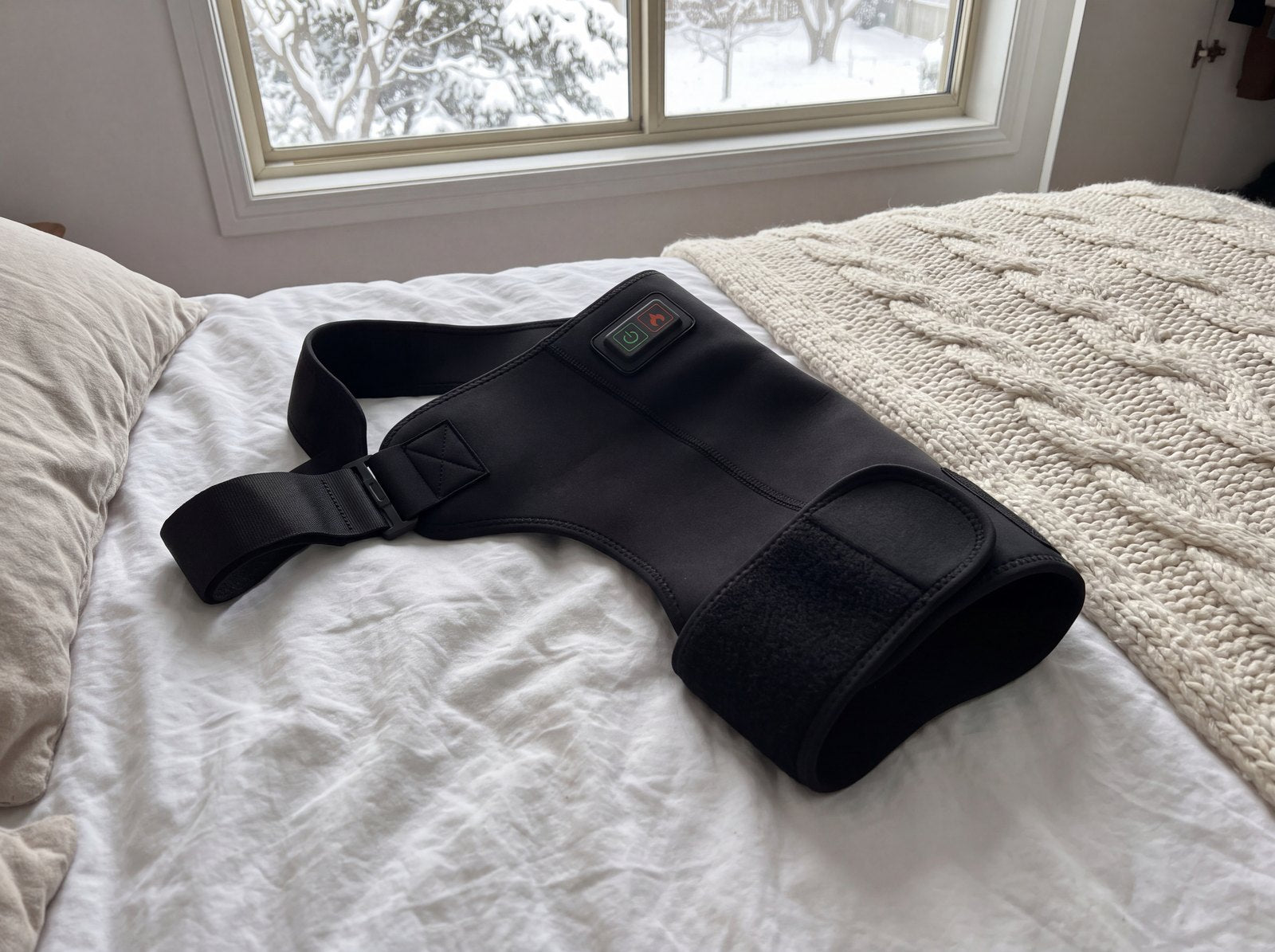
It does exactly the two things my reading had pointed to – deep heat to let the guarding muscles go and red light at 660 and 850nm to recharge the muscle cells – in one wrap, in 15 minutes. And it prints every one of those specifications on its page.
The whole idea behind the product is to reach the deep muscles around the hip in a gentle way – at home, before you sleep. In other words: to finally put my nights to work.
And when I read through the reviews from people with outer hip pain, side‑sleeping pain and "bursitis" that never cleared – some describing exactly my gluteal tendinopathy nights – I was instantly convinced.
One detail fascinated me the most: the first session.
Within minutes, a deep, soft warmth spreads into the side of the hip – and the muscles start to loosen while you sit there.
Most people feel the warmth and the first loosening in the very first session. The easier nights take longer – the makers are honest that they build over the first 2 to 3 weeks.
You can literally feel the muscles change while your nights get calmer.

Sleeping on my bad side for the first time in three years
"Three years of shots, out-of-pocket fees and 'come back when it's worse.' Bone on bone, right hip. Two weeks of 15 minutes a night with this and I woke up at 6am — on my bad side. I'd forgotten what that felt like."

Nine years of pain, off the daily Advil, first real sleep
"Hip pain for nine years and a cocktail of painkillers that left me with chronic gastritis. Two months in and I'm off the daily Advil. First proper sleep in years."

Ordered a second one for my husband
"I ordered one for myself and within three weeks my husband was 'borrowing' it every night. We now have two. I can get downstairs in the morning without holding both rails. Worth every penny."
How the Hip Restore works
The Hip Restore combines two mechanisms in one wrap that you put around the sore hip before bed.
It was designed for the hip, not adapted from a back or knee gadget with a strap.
Each session combines:
- Deep therapeutic heat – calibrated warmth that penetrates into the starved tissue and reopens blood vessels that have been squeezed shut
- 660 + 850nm red light – the two wavelengths studied in thousands of peer-reviewed papers on soft-tissue recovery, to switch the muscle cells' energy factories back on
- One button – no app, no Bluetooth, no setup
The principle is beautifully simple: as you sit on the edge of the bed, the wrap works on the deep muscles around the hip for 15 minutes. You lie down with warm, loose muscles – the kind of calm that the sleep research links with drifting off sooner.
Combined with a hip-friendly sleeping position, you're finally giving the night back to your recovery.
No pills to swallow, no needles anywhere near your hip, no appointments. Just 15 minutes before bed.
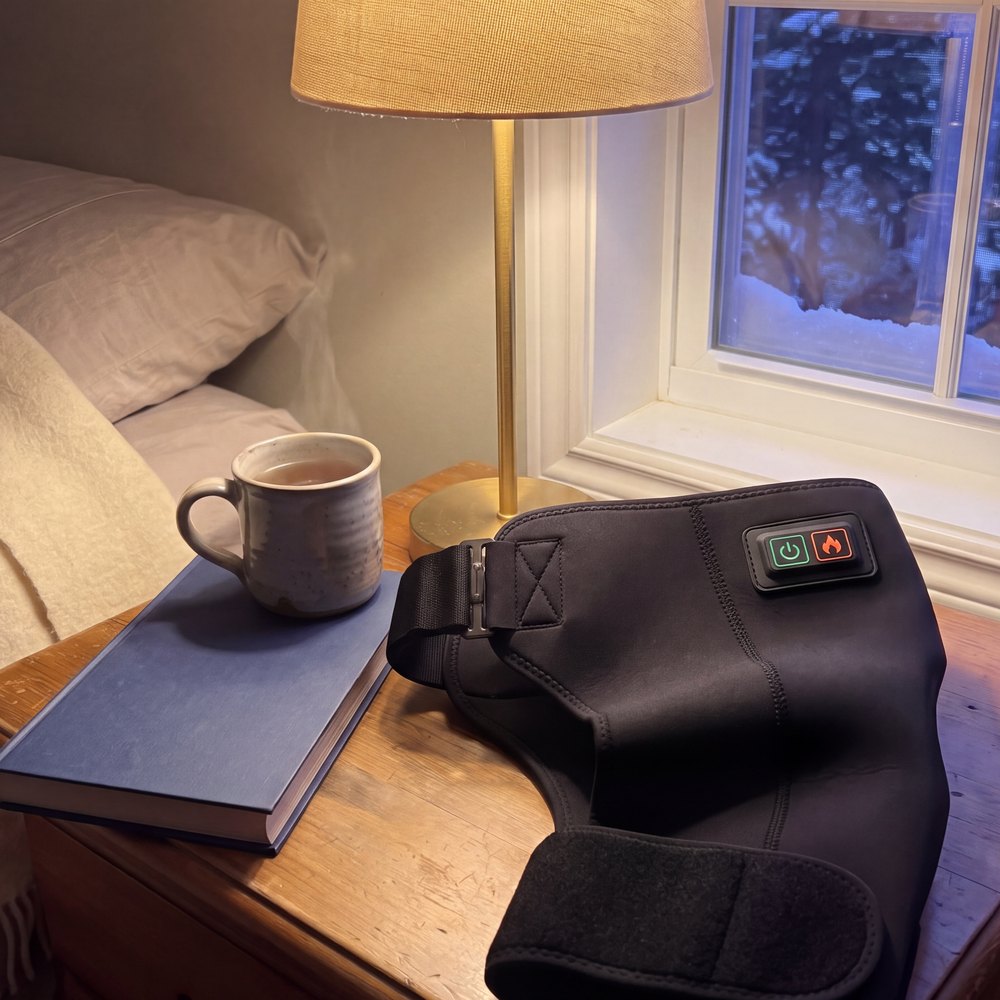
When the 15 minutes are up, you put it back in the drawer of the nightstand and use it again the next night.
My self-test with the Hip Restore begins
A few weeks later, I started using the Hip Restore every night before bed, put a pillow between my knees, stopped crossing my legs – and put the pill bottles away.
I was skeptical at first – after three years, how could 15 minutes before bed help where pills, cortisone and a foam roller had failed?
The very first session, I felt a deep, soft warmth spread into the side of my hip – and the first loosening in the muscles around it.
By the third week, I noticed the real difference: my nights were getting easier, and for the first time in months I slept through until morning.
Soon after, the burning had softened into a dull whisper. I sat through my niece's school play on a hard chair – something I'd been dreading for weeks.

After 6 weeks, I felt like a different person. I walked the full river trail on a snowy Saturday morning, took the stairs to my office without gripping the rail, and slept through most nights without that 3 a.m. burn.
One evening, I stood on my right leg in my kitchen – the same test my doctor had done – and held it. No flinch. No burn. I stood there until my coffee went cold.
Today I'm still sleeping, sitting and walking comfortably – because for the first time in three years, I wasn't just muting the symptom. I had stopped squeezing the tendon and given my nights back to my body.
That's why I can truly recommend this device to anyone whose outer hip pain sounds like mine, and I've linked the official Mendable Canada store below.
Best check right away whether it's still available at the sale price – right now, Black Friday pricing takes up to 60% off and adds three free gifts to every order:
- FREE eBook: "The Hip Recovery Blueprint" (C$39 value) · PDF by email
- FREE 90-Day Progress Tracker (C$19 value) · PDF by email
- FREE Pain-Free Sleep Positions Guide · PDF by email
C$58 in FREE gifts with every order
Click the button now and check the availability of the Mendable Hip Restore – Black Friday pricing takes up to 60% off for a limited time, and every order is covered by a 90-day money‑back guarantee, counted from the day it arrives.
Sale: Ends
Black Friday Sale - Up to 60% OFF
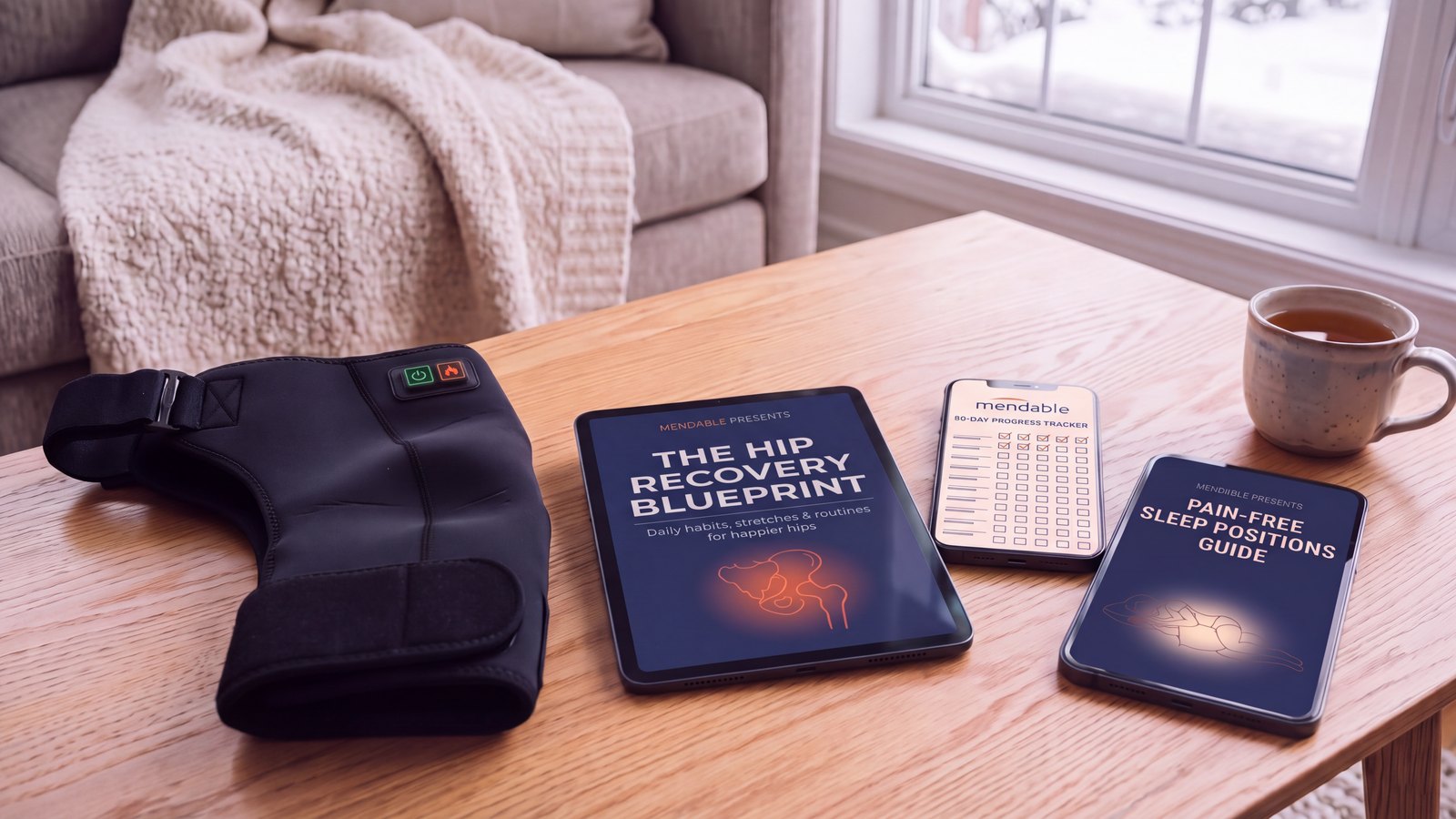
- Every order of the Mendable Hip Restore includes:
- FREE eBook: "The Hip Recovery Blueprint" (C$39 value) · PDF by email
- FREE 90-Day Progress Tracker (C$19 value) · PDF by email
- FREE Pain-Free Sleep Positions Guide · PDF by email
 90-Day Money-Back Guarantee
 Secure Checkout
 Free Canada-Wide Shipping, Tracked
About the author
Martha Collins is 56 years old and a freelance journalist. Told she had "hip bursitis" in her early fifties – which turned out to be gluteal tendinopathy – she spent three years fighting a burning ache on the outside of her right hip with pills, a cortisone shot, stretching and endless gadgets – without ever being told what was actually going on. When the pain kept getting worse despite doing everything "right", Martha took matters into her own hands and set out to find the real cause – and a drug-free way to get her nights back.
Sources
- Mellor et al., LEAP trial – education plus exercise vs corticosteroid injection vs wait-and-see, BMJ 2018
- Segal et al., Greater trochanteric pain syndrome: epidemiology and associated factors
- Gluteal Tendinopathy: Critical Analysis Review of Current Nonoperative Treatments, JBJS Reviews 2023
- Royal Orthopaedic Hospital (UK) – Gluteal tendinopathy information
- Kräuchi et al., Warm feet promote the rapid onset of sleep, Nature 1999
- Krause et al., The pain of sleep loss: a brain characterization in humans, Journal of Neuroscience 2019
Medical & Health Disclaimer: The information and other content provided in this page, or in any linked materials, are not intended and should not be construed as medical advice, nor is the information a substitute for professional medical expertise or treatment. Consult with a healthcare professional before starting any new treatment. Individual results may vary. Photos may show models. This is an advertisement for Mendable Hip Restore and not an actual news article, blog, or consumer protection update.
© 2026 Canadian Body Report